DSP Algorithms for RF Systems

New Book!

The third edition of DSP for Beginners: Simple Explanations for Complex Numbers! Includes a new chapter on sampling.

Using Euler’s Formula to Derive Sine and Cosine
November 24, 2021

Table of Contents

Introduction

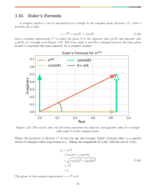
Cosine and sine can be written as the sum of two complex exponentials. Euler’s formula states

(1)   \begin{equation*}e^{j\omega} = \text{cos}(\omega) + j \text{sin}(\omega).\end{equation*}

More posts on complex numbers and complex sinusoids:

Cosine

To relate cosine add e^{-j\omega} to (1),

(2)   \begin{equation*}e^{j\omega} + e^{-j\omega} = \text{cos}(\omega) + j \text{sin}(\omega) + \text{cos}(\omega) - j \text{sin}(\omega).\end{equation*}

Simplifying the right side of (2),

(3)   \begin{equation*}e^{j\omega} + e^{-j\omega} = 2\text{cos}(\omega).\end{equation*}

Dividing (3) by 2,

(4)   \begin{equation*}\text{cos}(\omega) = \frac{1}{2}\left(e^{j\omega} + e^{-j\omega}\right).\end{equation*}

Sine

To relate sine subtract e^{-j\omega} from (1),

(5)   \begin{equation*}e^{j\omega} - e^{-j\omega} = \text{cos}(\omega) + j \text{sin}(\omega) - \text{cos}(\omega) + j \text{sin}(\omega).\end{equation*}

Simplifying the right side of (5),

(6)   \begin{equation*}e^{j\omega} - e^{-j\omega} = 2j\text{sin}(\omega).\end{equation*}

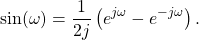
Dividing (6) by 2j,

(7)   \begin{equation*}\text{sin}(\omega) = \frac{1}{2j}\left(e^{j\omega} - e^{-j\omega}\right).\end{equation*}

Conclusion

Leave a Reply