
DSP Algorithms for RF Systems

Trending

New Book!

The third edition of DSP for Beginners: Simple Explanations for Complex Numbers! Includes a new chapter on sampling.

Product to Sum Trigonometric Identities with Euler’s Formula
June 15, 2022

Table of Contents

Introduction

cos(a) cos(b)

Start by substituting Euler’s formula in for both cosine terms,

(4)   \begin{equation*}\cos ( \alpha ) \cos ( \beta ) = \frac{1}{2} \left( e^{j\alpha} + e^{-j\alpha} \right) \cdot \frac{1}{2} \left( e^{j\beta} + e^{-j\beta} \right)\end{equation*}

Multiplying the right hand terms of (4),

(5)   \begin{equation*}\begin{split}\cos ( \alpha ) \cos ( \beta ) & = \frac{1}{4} \left( e^{j\alpha}e^{j\beta} + e^{j\alpha}e^{-j\beta} + e^{-j\alpha}e^{j\beta} + e^{-j\alpha}e^{-j\beta} \right) \\& = \frac{1}{4} \left( e^{j(\alpha + \beta)} + e^{-j(\alpha + \beta)} + e^{j(\alpha - \beta)} + e^{-j(\alpha - \beta)} \right).\end{split}\end{equation*}

Simplifying (5) with Euler’s formula results in

(6)   \begin{equation*}\frac{1}{4} \left( e^{j(\alpha + \beta)} + e^{-j(\alpha + \beta)} \right) = \frac{1}{2} \cos (\alpha + \beta),\end{equation*}

(7)   \begin{equation*}\frac{1}{4} \left( e^{j(\alpha - \beta)} + e^{-j(\alpha - \beta)} \right) = \frac{1}{2} \cos ( \alpha - \beta),\end{equation*}

such that

(8)   \begin{equation*}\cos (\alpha) \cos (\beta) = \frac{1}{2} \left( \cos(\alpha + \beta) + \cos (\alpha - \beta) \right).\end{equation*}

sin(a) sin(b)

Start by substituting Euler’s formula in for both sine terms,

(9)   \begin{equation*}\sin(\alpha) \sin(\beta) = \frac{1}{2j} \left( e^{j\alpha} - e^{-j\alpha} \right) \cdot \frac{1}{2j} \left( e^{j\beta} - e^{-j\beta} \right).\end{equation*}

Multiplying the right hand terms of (9),

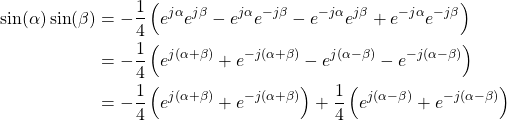
(10)   \begin{equation*}\begin{split}\sin(\alpha) \sin(\beta) & = -\frac{1}{4} \left( e^{j\alpha}e^{j\beta} - e^{j\alpha}e^{-j\beta} - e^{-j\alpha}e^{j\beta} + e^{-j\alpha}e^{-j\beta} \right) \\& = -\frac{1}{4} \left( e^{j(\alpha + \beta)} + e^{-j(\alpha + \beta)} - e^{j(\alpha - \beta)} - e^{-j(\alpha - \beta)} \right) \\& = -\frac{1}{4} \left( e^{j(\alpha + \beta)} + e^{-j(\alpha + \beta)} \right) + \frac{1}{4} \left( e^{j(\alpha - \beta)} + e^{-j(\alpha - \beta)} \right) \\\end{split}\end{equation*}

Simplifying (10) with Euler’s formula results in

(11)   \begin{equation*}\frac{1}{4} \left( e^{j(\alpha + \beta)} + e^{-j(\alpha + \beta)} \right) = \frac{1}{2} \cos (\alpha + \beta),\end{equation*}

(12)   \begin{equation*}\frac{1}{4} \left( e^{j(\alpha - \beta)} + e^{-j(\alpha - \beta)} \right) = \frac{1}{2} \cos ( \alpha - \beta),\end{equation*}

such that

(13)   \begin{equation*}\sin(\alpha) \sin(\beta) = \frac{1}{2} \left( \cos(\alpha - \beta) - \cos(\alpha + \beta) \right).\end{equation*}

cos(a) sin(b)

Start by substituting Euler’s formula in for cosine and sine,

(14)   \begin{equation*}\cos (\alpha) \sin(\beta) = \frac{1}{2} \left( e^{j\alpha} + e^{-j\alpha} \right) \cdot \frac{1}{2j} \left( e^{j\beta} - e^{-j\beta} \right).\end{equation*}

Multiplying the right hand terms of (14),

(15)   \begin{equation*}\begin{split}\cos (\alpha) \sin(\beta) & = \frac{1}{4j} \left( e^{j\alpha}e^{j\beta} - e^{j\alpha}e^{-j\beta} + e^{-j\alpha}e^{j\beta} - e^{-j\alpha}e^{-j\beta} \right) \\& = \frac{1}{4j} \left( e^{j(\alpha+\beta)} - e^{-j(\alpha+\beta)} - e^{j(\alpha - \beta)} + e^{-j(\alpha - \beta)} \right) \\\end{split}\end{equation*}

Simplifying (15) with Euler’s formula results in

(16)   \begin{equation*}\frac{1}{4j} \left( e^{j(\alpha+\beta)} - e^{-j(\alpha+\beta)} \right) = \frac{1}{2} \sin( \alpha + \beta),\end{equation*}

(17)   \begin{equation*}\frac{1}{4j} \left( e^{j(\alpha - \beta)} - e^{-j(\alpha - \beta)} \right) = \frac{1}{2} \sin (\alpha - \beta),\end{equation*}

such that

(18)   \begin{equation*}\cos (\alpha) \sin(\beta) = \frac{1}{2} \left( \sin( \alpha + \beta) - \sin (\alpha - \beta) \right).\end{equation*}

Conclusion

The product to sum trigonometric identities were proven using Euler’s formula. 

More blogs on DSP Math:

Leave a Reply