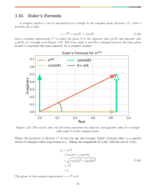
![Figure 2: The complex sinusoid x0[n] = e(j2 pi 0.125 n) plotted in the complex plane.](https://www.wavewalkerdsp.com/wp-content/uploads/wordpress-popular-posts/3104-featured-125x100.png)

A previous blog described how a specific implementation of a single pole IIR filter can be used to approximate a low pass moving average filter. The impulse response of this filter is defined as
(1) ![\begin{equation*}y[n] = \alpha x[n] + \left( 1-\alpha\right)y[n-1] \end{equation*}](https://www.wavewalkerdsp.com/wp-content/ql-cache/quicklatex.com-451293840b20cb0acc5a6dabe9b83dec_l3.png "Rendered by QuickLaTeX.com")
which may also be referred to as an exponential moving averager or a leaky integrator. The impulse response in (1)
is simplified by setting
(2) 
such that
(3) ![\begin{equation*}y[n] = \alpha x[n] + \beta y[n-1].\end{equation*}](https://www.wavewalkerdsp.com/wp-content/ql-cache/quicklatex.com-d2d797df8b2a2261a85ddddeece6b54f_l3.png "Rendered by QuickLaTeX.com")
The frequency response for the low pass filter (LPF) (3) is
(4) 
The LPF single pole IIR filter can be transformed into a band pass filter (BPF) through complex frequency shifting. The center frequency of the band pass filter is defined to be  and the frequency is shifted according to the substitution
(5) 
The frequency response for the BPF filter is therefore
(6) 
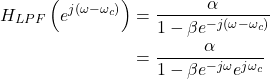
The LPF frequency response (4) is substituted into (6),
(7) 
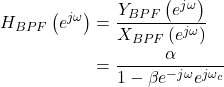
The frequency response is represented using the output  and the input
(8) 
which is rearranged into
(9) 
and simplified as
(10) 
The impulse response is obtained by applying the inverse Z-transform
(11) ![\begin{equation*}y[n] - \beta e^{j\omega_c} y[n-1] = \alpha x[n]\end{equation*}](https://www.wavewalkerdsp.com/wp-content/ql-cache/quicklatex.com-2d5eead34bafbae0b311bcef2f6d388b_l3.png "Rendered by QuickLaTeX.com")
which is more commonly written as
(12) ![\begin{equation*}y[n] = \alpha x[n] + \beta e^{j\omega_c} y[n-1].\end{equation*}](https://www.wavewalkerdsp.com/wp-content/ql-cache/quicklatex.com-445cf10b0ff5992f7000cbb573955548_l3.png "Rendered by QuickLaTeX.com")
The feedback filter coefficient for the LPF is  however the bandpass version includes a complex weight
  .
.
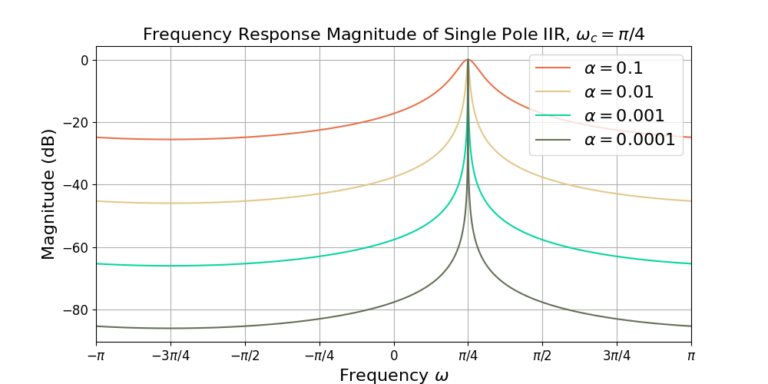
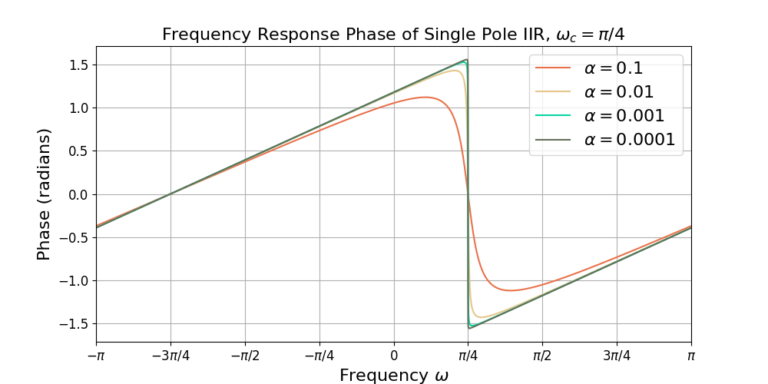
The following plots show the frequency response for the band pass single pole IIR with  . Figure 1 gives the magnitude of the frequency response and Figure 2 gives the phase of the frequency response. Compare the plots against the LPF in the previous blog post.